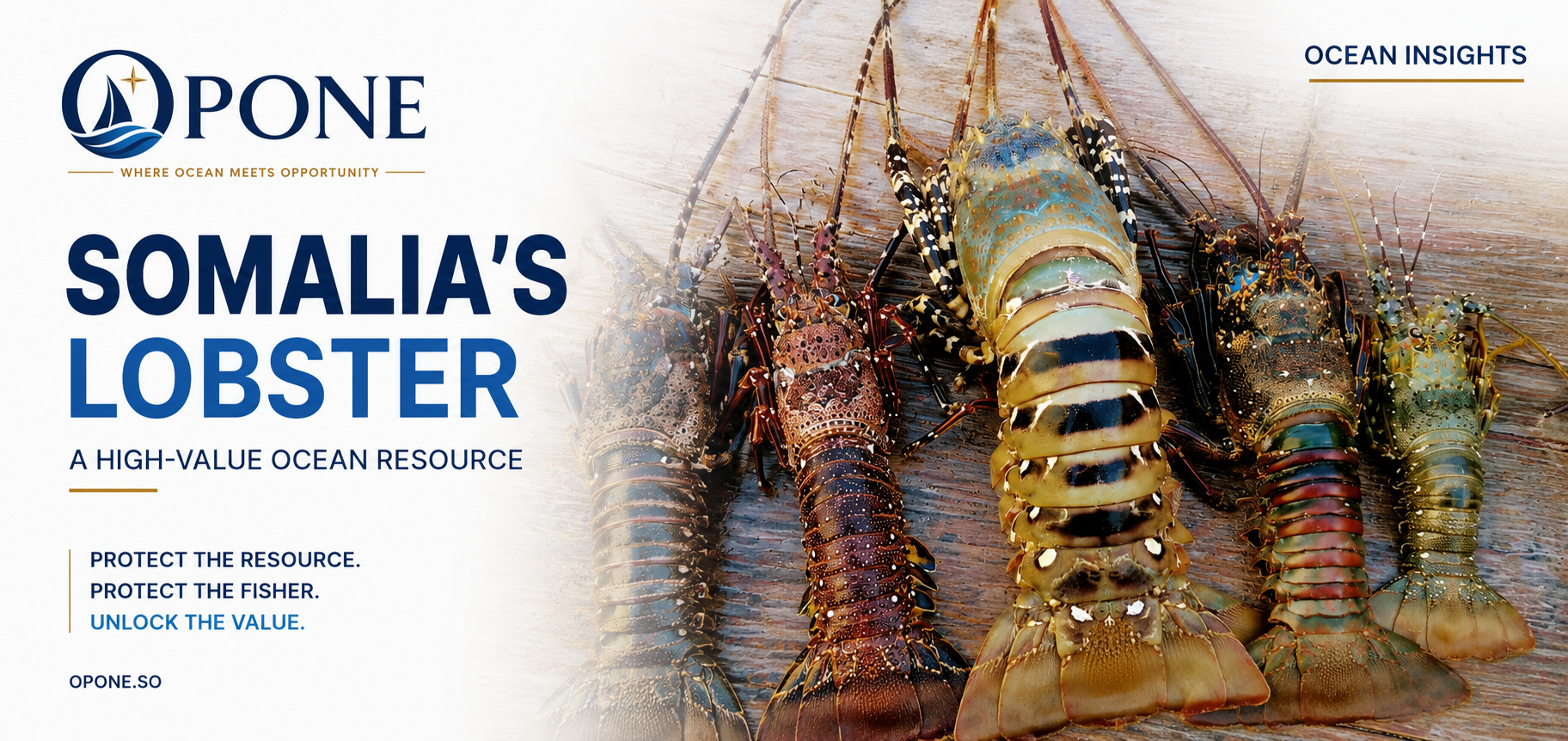
Somalia’s Lobster: A High-Value Ocean Resource
Ocean Insights | OPONE
Somalia’s marine waters hold a wide range of commercially valuable resources, yet many remain significantly underdeveloped. Among them, lobster stands out as a high-value fishery with a long history of commercial exploitation and a close connection to coastal livelihoods and export markets.
For OPONE, the question is not simply how much lobster Somalia can harvest. The more important question is how Somalia can build a lobster value chain that creates greater economic value while protecting the resource and the fishermen who depend on it.
A Resource with a Long History
Lobster fishing is not new to Somalia. FAO species-identification surveys have documented both spiny lobster in shallow coastal waters and deep-water lobster resources along Somalia’s Indian Ocean coast. Earlier commercial operations, including foreign and joint-venture fishing companies, targeted the deep-water stock, while small-scale Somali fishers harvested spiny lobster closer to shore.
Somalia’s lobster sector was not a purely domestic industry. Historical fisheries records show that Somali marine products, lobster included, entered international trade channels during the 1970s and 1980s, supported by licensed foreign fishing operations and joint ventures such as the Somali High Seas Fishing Company (SHIFCO), an Italian partnership established in 1983 that landed much of its catch abroad.
This history demonstrates that Somalia’s lobster resources have already participated in international seafood markets. The challenge now is building a modern system capable of doing so sustainably and consistently.
High Value Does Not Automatically Mean High Development
Lobster commands substantially higher market value than most conventional fish products. This creates an attractive opportunity for coastal communities, but it also creates a management risk: when a resource carries high commercial value, fishing pressure can increase faster than monitoring and enforcement systems can keep pace.
This concern is well documented. Somalia’s fisheries sector continues to operate with limited catch and stock data, and FAO has noted anecdotal evidence suggesting that coastal lobster fishing already exceeds sustainable limits in a number of areas along the coast.
This makes one principle particularly important: the objective should not be to catch more lobster. The objective should be to create more value from a sustainably managed lobster resource.
Protect the Resource. Protect the Fisher. Unlock the Value.
A stronger lobster industry requires more than boats and fishing gear. It requires a functioning value chain.
- For fishermen, that means access to appropriate equipment, safety systems, finance, technical knowledge and reliable markets.
- For the value chain, it means better landing facilities, hygienic handling, ice and cold storage, transportation and processing capacity.
- For exporters, it means consistent quality, traceability and access to international markets.
- For government, it means the ability to collect reliable data, establish appropriate management measures and enforce them effectively.
FAO’s current work in Somalia reflects this broader approach, with programmes focused on modern infrastructure, technical expertise, value-chain development, market access, improved handling and stronger support for coastal fishing communities.
The Cold Chain Is Part of the Opportunity
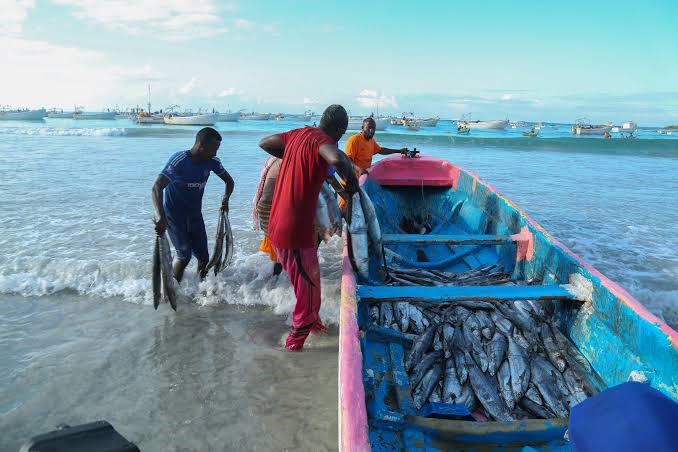
For a high-value seafood product such as lobster, quality begins immediately after landing. Poor handling, inadequate icing, delayed transportation and insufficient cold storage all reduce product quality — and with it, the value captured by fishermen and businesses alike.
This is why investment in landing sites, ice production, cold storage, refrigerated transportation and processing should be treated as part of the lobster opportunity itself, not as separate infrastructure projects. The same principle applies across Somalia’s wider fisheries sector: current FAO initiatives place clear emphasis on improved hygiene, storage, refrigeration and handling infrastructure to strengthen market access.
From Raw Resource to Value Chain
The greatest opportunity may lie beyond simply selling lobster as a raw commodity. Somalia could progressively develop a more integrated lobster value chain involving:
- Sustainable harvesting
- Fisher aggregation
- Quality grading
- Ice and cold-chain services
- Processing and packaging
- Traceability
- Export logistics
- Market intelligence
- Sustainable seafood certification
- Higher-value seafood products
Building this chain would allow a larger share of the final economic value to remain within the Somali economy. It would also create opportunities for coastal enterprises beyond fishing itself — cold-chain operators, processors, logistics companies, traders, equipment suppliers and financial-service providers.
Data Must Come Before Scale
There is, however, a critical constraint that should not be ignored: Somalia still lacks sufficiently consistent fisheries data. The country has struggled for decades to maintain comprehensive fisheries statistics, making it difficult to accurately assess catches and the condition of fish stocks.
This is beginning to change. In November 2025, the Federal Government of Somalia and FAO formally launched a new Fisheries Information Management System (FIMS), part of the World Bank–funded, $55 million Somalia Sustainable Fisheries Project (“Badmaal”) implemented by the Ministry of Fisheries and Blue Economy. The system is designed to standardise the collection, storage and analysis of fisheries data and make it accessible to decision-makers at state and federal level — a step FAO has identified as essential to preventing over-exploitation of Somalia’s fisheries resources.
This matters enormously for lobster. Before expanding commercial exploitation, Somalia needs to understand:
- Where lobster stocks are concentrated
- Which species are being harvested
- Catch volumes and fishing effort
- Size and maturity of landed lobster
- Seasonal patterns and spawning periods
- Fishing mortality
- Local and export market prices
- The economic contribution to fishing communities
Without this information, increasing fishing effort remains a gamble.
A Blue-Economy Opportunity — But Only If Managed Well
Somalia’s lobster resource illustrates a broader principle for the country’s Blue Economy: natural resources alone do not create a Blue Economy. Value is created when natural resources are connected to infrastructure, knowledge, finance, markets, technology and effective institutions.
Lobster is therefore more than a seafood product. It is a potential entry point into a wider coastal economic system. The opportunity is to move from:
Resource → Catch → Sale
toward:
Resource → Sustainable Fishery → Quality → Processing → Market → Value Creation
That transition is where the real economic opportunity lies.
OPONE’s Perspective
At OPONE, we believe Somalia’s maritime opportunity should be approached through both resource protection and value creation. Lobster demonstrates why: the country has a valuable marine resource and a historical connection to international seafood markets, but unlocking its full potential requires a modern fisheries ecosystem built around sustainable management, empowered fishermen, reliable data, appropriate infrastructure and competitive markets.
The objective should not be simply to increase the quantity harvested. It should be to increase the value generated per sustainably harvested lobster, while ensuring coastal communities benefit from the resource.
Protect the resource. Protect the fisher. Unlock the value.
OPONE — Where Ocean Meets Opportunity.
Ocean Insights is OPONE’s research and editorial platform exploring Somalia’s maritime resources, industries, infrastructure, policy and emerging Blue Economy opportunities.
Sources: FAO, The Living Marine Resources of Somalia (Species Identification Field Guide, 1996); FAO Fishery Country Profile: Somalia; FAO, “Development of a Fisheries Information Management System for Somalia will transform important industry” (November 2025); World Bank, Somalia Sustainable Fisheries (“Badmaal”) Project documentation.