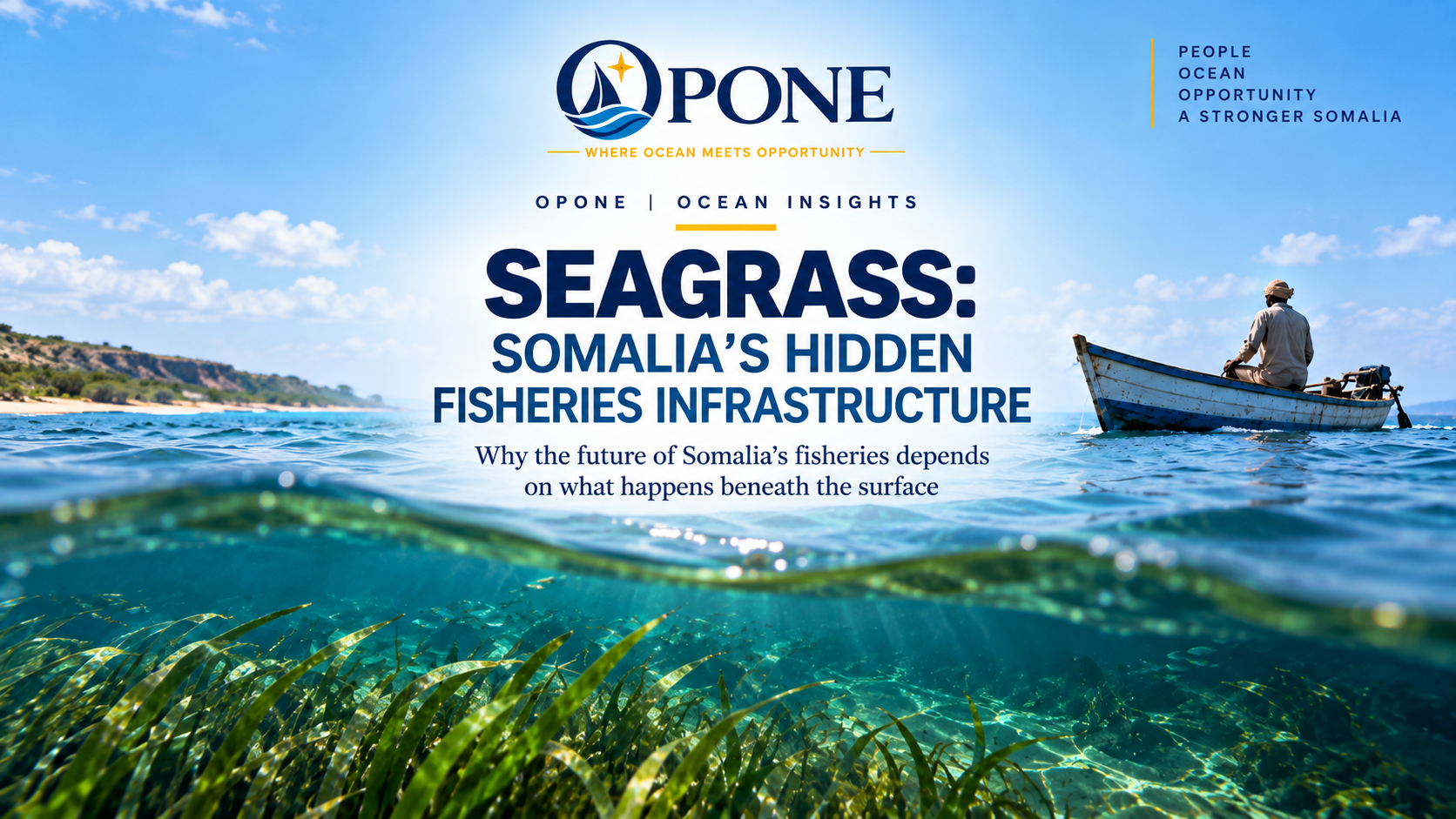
Somalia’s Blue Economy debate is dominated by ports, boats and cold chains. But the ecosystems that produce the fish in the first place remain largely unmapped — and that is a problem for the economy, not just the environment.
By OPONE — Where Ocean Meets Opportunity
The infrastructure that doesn’t appear on a balance sheet
Somalia’s fisheries conversation usually begins with what can be seen: boats, fishermen, landing sites, markets, ports, cold storage, processing facilities, exports.
All of it matters. None of it is sufficient.
Beneath the surface lies another form of infrastructure — one that attracts far less attention because it has no concrete walls, cranes or warehouses. Seagrass meadows provide habitat and nursery functions for marine life, stabilise sediments, and contribute to the ecological productivity on which coastal fisheries depend. In Somalia, documented seagrass habitats form part of a broader coastal system linking marine ecosystems, fisheries and coastal communities.
Which raises a question that deserves far more attention than it currently receives: if Somalia wants to build a stronger fisheries economy, are we paying enough attention to the ecosystems that produce the fish?
Somalia has seagrass. What it lacks is knowledge.
Seagrass is not a hypothetical presence in Somali waters. It has been documented for decades.
Historical research describes extensive meadows along parts of the southern coast, particularly from Adale toward Ras Chiamboni. Somalia’s Blue Economy Assessment identifies seagrass beds along the southern coast and in the Bajuni Sound, including communities of Thalassodendron and Syringodium.
The challenge is not whether seagrass exists. It is that Somalia still lacks sufficiently detailed information about its national extent, condition and change over time. Available global habitat datasets capture only a limited portion of Somalia’s seagrass — a figure that should never be read as the total area in Somali waters. It is a measure of how incomplete the spatial baseline remains, not of how much seagrass there is.
That distinction matters, because effective marine management begins with knowing what exists, where it exists, and how it is changing.
A connected coastline
Somalia’s southern coastline forms part of the Somali Current Large Marine Ecosystem, a highly productive region shaped by seasonal oceanographic processes and upwelling. The coastal environment contains an interconnected mosaic of coral reefs, mangroves, seagrass meadows, beaches, estuaries and shallow habitats. The Bajuni Archipelago is especially significant, with islands, channels, mangroves, coral habitats and seagrass occurring within a single broader system.
These ecosystems do not function in isolation. Organisms, nutrients, sediments and energy move between them. For fisheries, that connectivity can be decisive.
What seagrass does for fisheries
The important question for Somalia is not whether seagrass is a beautiful marine ecosystem. It is what a healthy seagrass ecosystem means for fish.
Seagrasses are marine flowering plants whose leaves, roots and rhizomes create complex habitat capable of supporting diverse marine communities. Research from Somalia has documented extensive Thalassodendron meadows across parts of the shallow continental shelf, including their role in binding sediments and supporting associated organisms. Across the Western Indian Ocean, scientific work has demonstrated the importance of seagrass as nursery habitat for juvenile fish, with recent regional research providing particularly strong evidence for juvenile rabbitfish recruitment in Madagascar.
The lesson should not be overstated. Seagrass does not determine fish abundance on its own, and not every fishery depends on it in the same way. But healthy coastal habitats support ecological processes that contribute to the replenishment of fish populations.
The chain is straightforward:
Seagrass → habitat → juvenile fish → recruitment → fish stocks → fisheries → coastal livelihoods
This is why seagrass belongs in the category of natural infrastructure.
Natural infrastructure is still infrastructure
When Somalia discusses fisheries development, attention rightly goes to what is built. Landing sites, ice, cold chains, storage, processing, transport, markets, energy, digital information and financial services are all necessary to move fish from the sea to the consumer.
But another system comes first: the ecological system that sustains the resource itself.
A cold chain can prevent a fish from spoiling. A landing site can improve how it reaches the market. Processing can increase its value. None of these systems can manufacture a healthy marine ecosystem.
Built infrastructure moves value. Natural infrastructure helps generate the resource from which that value is created.
This is not an argument that seagrass alone determines the future of Somali fisheries. Fishing pressure, oceanographic conditions, species biology, habitat connectivity, governance and climate variability all matter. But habitat condition belongs inside the fisheries conversation, not alongside it.
Beyond fisheries: coastal protection and biodiversity
The value of seagrass does not end with fish. Roots and rhizomes bind sediments, while meadow structure influences water movement and sediment dynamics. Historical research from Somalia describes Thalassodendron meadows as contributing to sediment trapping and seabed formation, and regional Western Indian Ocean guidance recognises seagrass as relevant to coastal protection and restoration.
Seagrass is also part of a wider biodiversity system, providing feeding habitat for species such as green turtles and remaining ecologically relevant to dugongs where suitable meadows exist.
Here, scientific discipline matters. The available evidence does not justify portraying Somalia as holding a major dugong population. The defensible conclusion is narrower and more useful: protecting suitable seagrass habitat helps maintain the ecological conditions that dependent species require.
For a country whose coastal communities are so closely tied to the sea, these ecological functions carry economic and social weight.
Blue carbon: sequence matters
There is another reason seagrass deserves attention — carbon.
Seagrass ecosystems capture and store carbon in their biomass and in the sediments beneath their meadows. Somalia’s Blue Economy Assessment identifies seagrasses among the country’s potential blue-carbon ecosystems and calls for further investigation.
But Somalia should resist moving faster than the evidence. The first question is not “how many carbon credits can Somalia sell?” It is: where are these ecosystems, what condition are they in, how much carbon do they hold, and can those estimates be independently verified?
Credible carbon-market projects require robust baselines, additionality, permanence, leakage management and safeguards against double counting. The logical sequence is therefore:
Map → measure → monitor → protect → restore where appropriate → consider financing
Not: sell credits, then look for the ecosystem.
That distinction will shape the credibility of Somalia’s emerging Blue Economy — and, in time, its access to serious international capital.
The pressures are real. Their magnitude is not yet known.
Seagrass ecosystems across the Western Indian Ocean face sedimentation, coastal development, pollution, physical disturbance, fishing pressure, anchoring and boat damage, eutrophication and climate-related stress. Somali assessments have identified broader pressures on coastal ecosystems, including degradation, pollution, overexploitation and inadequate monitoring.
An important qualification follows: the magnitude of individual threats to Somalia’s seagrass meadows has not been sufficiently quantified. That uncertainty should not be hidden. It should be treated as a research priority.
Good ocean policy begins with good evidence.
The next opportunity is knowledge
There are encouraging signs that Somalia’s marine knowledge base can improve. A two-year coastal biodiversity survey led by the Somali National University Marine Biology Unit is expected to examine 24 coastal sites from Berbera to Kismayo, documenting fish, coral reefs, seagrass meadows, mangroves, turtle nesting sites and marine mammals. The intended outcome is a comprehensive marine biodiversity atlas capable of informing fisheries policy and marine protected-area decisions.
This could become a foundation for better marine governance, because Somalia cannot effectively manage ecosystems that remain poorly mapped and poorly monitored. The first step in stewardship is knowledge.
Protect first. Restore where it makes sense.
There is a danger in assuming restoration is always the answer. Restoration is not a substitute for protection.
Regional Western Indian Ocean guidance emphasises that seagrass restoration is technically challenging, context-specific and dependent on local environmental conditions. For Somalia, the priority is sequential: understand existing meadows and the pressures affecting them; reduce those pressures and protect important habitats; then restore where there is a sound ecological and economic case.
Sometimes the most effective restoration strategy is simply preventing further damage.
From “catch more” to “create more value”
Fisheries production and conservation are too often treated as separate conversations — one asking how much fish Somalia can catch, how many boats it can operate, how to increase landings and expand exports; the other asking how to protect ecosystems and reduce degradation.
They are not competing agendas. The more useful question is how Somalia can create greater long-term economic value from fisheries without undermining the ecological systems that sustain them. That is the real test of a mature Blue Economy.
Consider the full value chain. Healthy marine ecosystems support fish production. Responsible harvesting brings fish to shore. Landing infrastructure, ice, cold-chain systems, processing, packaging and markets then add economic value. The value created at the end of that chain depends, in part, on what happens at the beginning. If marine ecosystems deteriorate and stocks decline, everything downstream becomes harder to sustain.
Ocean stewardship is not the opposite of fisheries development. It is one of its foundations.
Toward a Somali marine knowledge economy
Better marine ecological knowledge would support a far broader agenda: strengthening fisheries management, informing marine spatial planning, establishing credible blue-carbon baselines, supporting community stewardship, improving marine education, and helping investors identify genuinely sustainable opportunities.
These are not only environmental priorities. They are economic ones. This is where knowledge becomes economic infrastructure.
Somalia does not only need to use its ocean. It needs to understand it. That means building capacity in marine biology, fisheries science, oceanography, remote sensing, habitat mapping, climate science, fisheries economics, marine spatial planning, community-based monitoring and digital ocean information systems.
The emerging national biodiversity survey can therefore become more than a scientific exercise. It can help lay the foundation of a Somali marine knowledge economy — one in which government institutions, universities, coastal communities, private-sector organisations and international research networks each contribute complementary capabilities.
The questions Somalia should be asking
The question is not yet “how much seagrass does Somalia have?”
The more important questions are these. Where is it? What condition is it in? What lives there? Which fisheries are associated with it? Which communities depend on those fisheries? What pressures are affecting it? What should be protected, and what should be restored? And how can healthy ecosystems contribute to sustainable economic value?
Answering them would move Somalia from environmental awareness toward evidence-based Blue Economy management.
Conclusion
Somalia’s Blue Economy will not be built only at ports, markets and processing facilities. Part of it is already being built — or lost — beneath the surface: in seagrass meadows, in mangrove channels, around coral habitats, across productive fishing grounds, and within the marine food webs that sustain coastal communities.
Much of this natural infrastructure remains poorly mapped, insufficiently monitored and largely absent from mainstream economic conversations. That needs to change.
We should not romanticise seagrass. We should not exaggerate what the current evidence can prove. And we should not rush into restoration or carbon markets without the necessary science. What Somalia needs instead is a disciplined approach: know the ocean, map the habitats, understand the fisheries, protect what matters, restore where it works, and create value responsibly.
Because the Blue Economy is not simply about what we can take from the ocean. It is about whether we can build an economy that stays productive because the ocean stays healthy.
Perhaps that is the lesson hidden beneath Somalia’s seagrass: before asking how much more we can take from the sea, we should understand what makes the sea productive in the first place.
Protect the habitat. Protect the fishery. Protect the future.
OPONE — Where Ocean Meets Opportunity
BADDEENA. FURSADEENA.